
Share This Article



,j
People picture Valentine’s Day as when the sweet smell of cocoa wafts through the air, and red and pink decorations color much of the world. Two weeks after that day, the decorations in Japan are gradually changing to pink, green and white for the special event, the Doll’s Festival.
On March 3, a traditional Japanese event will take place. It is the Doll’s Festival known as “Hinamatsuri.” People in Japan celebrate it to pray for girls’ healthy growth and happiness. Since there is another day for boys, Hinamatsuri primarily applies to families with girls. On that day, they eat special dishes and snacks while decorating Hina dolls, which are traditional dolls for Hinamatsuri.
Sponsored Link
.
.
Hinamatsuri has been celebrated since the Heian period. The origin is said to be a combination of two customs of the time.
1. Nagashi-bina
In China, long ago, there was a custom of purifying oneself in a river to ward off evil spirits and disasters. The custom was introduced to Japan, but the dolls took the place of people’s walking in a river with the misfortune. These paper and grass dolls floated down the river to wish people good health and happiness. This is called “Nagashi-bina.”
2. Playing with Hina
At that time, playing house (dressing up dolls made of paper) was popular among aristocratic children. This is called “Hina-asobi.” Thus, it is said that two of those, “Nagashi-bina” and “Hina-asobi,” were combined and became the origin of the current Hinamatsuri.
.
But how has the origin of flushing become the current method of decorating Hina dolls?
The reason is simple: the river became polluted due to the flushing of paper-made dolls every year. Therefore, instead of flushing them, people started to decorate dolls. Although it was an annual event to purge all people of bad health and misfortune, gradually the focus became on children, especially girls, and they began to enjoy decorating their dolls in colorful ways.
.
What specifically do people do for Hinamatsuri today?
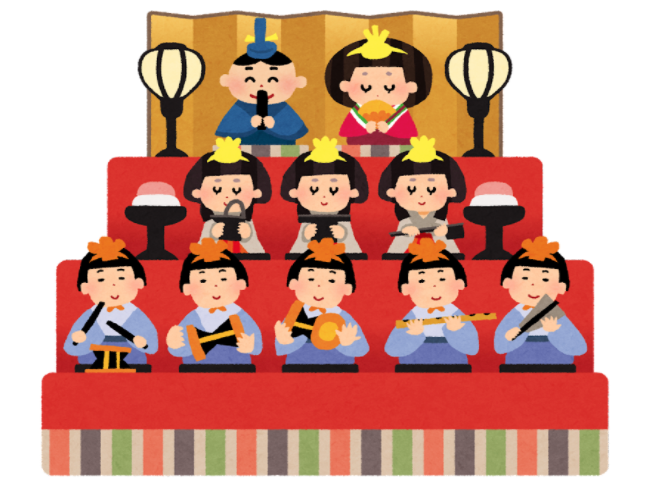
Most families with young girls display special Hina dolls at their house. A set of Hina dolls is displayed on a five or seven-tiered stand covered with a red carpet. On the first level, it includes “Odairi-sama” meaning the Emperor and “Ohina-sama” meaning the Empress. On the second and the other levels, their court ladies, ministers and servants are displayed.
Interestingly, people in the Tokyo area and people in the Kyoto area place the emperor and empress oppositely. After March 3, they put them away as soon as possible, otherwise the girls in that household will get married late.
.
On Hinamatsuri, families with girls also eat special dishes and snacks.
.
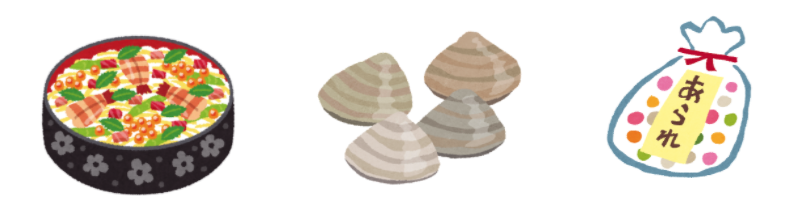
The most popular traditional dishes are chirashi-zushi and cherrystone clam soup. Although some people may know chirashi-zushi, it is a kind of sushi with many scattered toppings, such as salmon roe and vegetables on vinegared rice. Each colorful topping is likened to lucky charms, so people eat it for Hinamatsuri. They also eat cherrystone soup. Traditionally, the shells of cherrystone clams are the symbol of happiness between married couples, so parents prepare the soup hoping their daughter will come across a good partner.
;
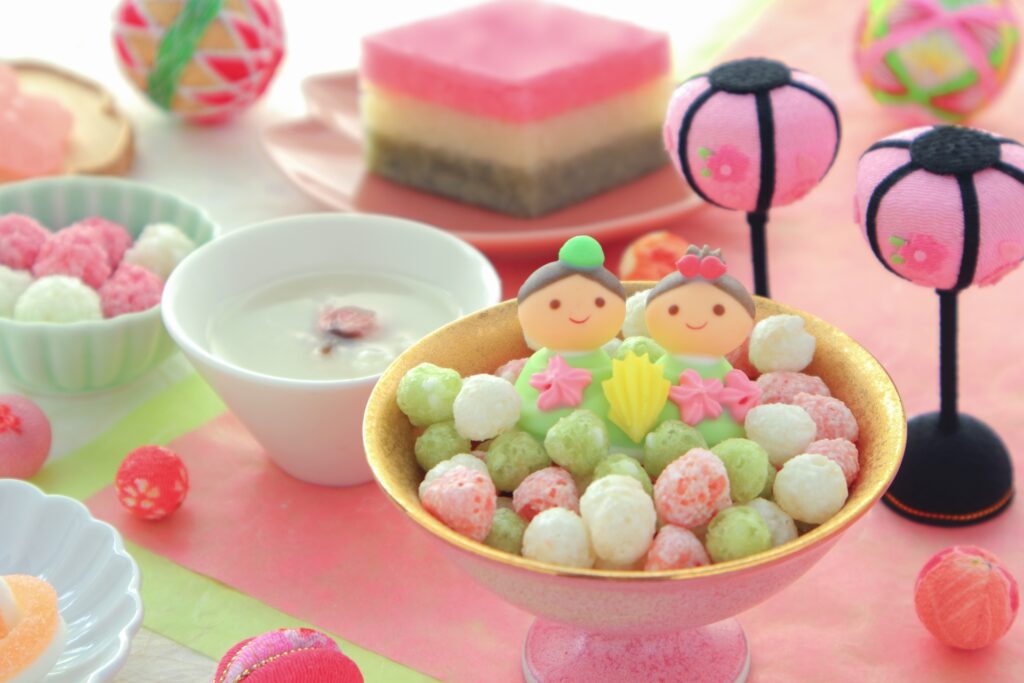
After the dishes, dessert is a must! Here is a special snack called “Hina-arare” for Hinamatsuri.
.
Hina-arare are bite-sized sweet rice crackers and used to be eaten by aristocratic children when they played with dolls. Additionally, each piece is colored pink, white or green and has its own meaning. Pink means “life,” white means “snowy earth” and green means “budding trees.” Indeed, there are many theories about the meaning of colors, and this is just one theory.
.
As we spent time learning about the origin of Hinamatsuri as well as the ways of celebrating it, nowadays, many families just display Hina dolls or eat only some dishes to make the celebration easier. Besides, as girls grow up, they no longer celebrate Hinamatsuri. However, many special events still take place, and some public places exhibit large Hina dolls. The beauty of it attracts not only children but also adults.
While the value of the day has changed as time goes by, many people, regardless of age and gender, enjoy celebrating it. Hinamatsuri is coming in less than two weeks. So, what are you going to do on March 3 this year?
.
Do you want to explore Hinamatsuri more? Here is a good video!
.
.
Writer: Mao Kimura
Mao’s Instagram
(2/21/2022)
Share This Article
NEW MAGAZINE
Related Articles
Pick Up
- The Half-Price Rush: Surviving the Twilight Hour at ...
- The Feline Kingdom: Why Cats Vastly Outnumber Humans...
- The Fluffiest Mob: The Dark History and Cute Reality...
- The Art of Not Saying “No”: How to Decod...
- The “L” and “R” Illusion: Wh...
-

- JAPANESE SAMURAI /Tsunenaga Hasekura
- The Infinite Loop: Why Tokyo’s Yamanote Line i...
- Shattering the Myth: Why Real Japanese Ninjas Never ...
- The $0 Emergency: Why Calling an Ambulance in Japan ...
- The “Yes Means No” Trap: Why Answering a...
- See more TRADITIONAL CULTURE articles >









Latest Articles
- Perfect for Your Summer Trip to Japan!Hello Japan SI...
- 【Now Open!】The Ultimate Nationwide Bilingual Job B...
- JapanUp! 224 – June 2026
- [Japanese Interviews: Life in LA] Yuki Mitsufuji : B...
- YUKI SAORI in LOS ANGELES ~From 1969 to the Future~ ...
-

- [Japanese Interviews: Life in LA] Yukari Fowler : Tr...
- The “Tokyo” Trap: Why Are Tokyo Disneyla...
- The $3,000 Obstacle Course: Why Getting a DriverR...
- Why Do Japanese People Go to the Doctor for a Simple...
- Why Don’t Japanese People Throw Home Parties? ...
- See all articles >









Thanks for the very interesting history and customs behind the Hina Festival.
A nice easy going read.
I enjoyed the video, too.
Looking forward to your next piece.