Share This Article



.
.
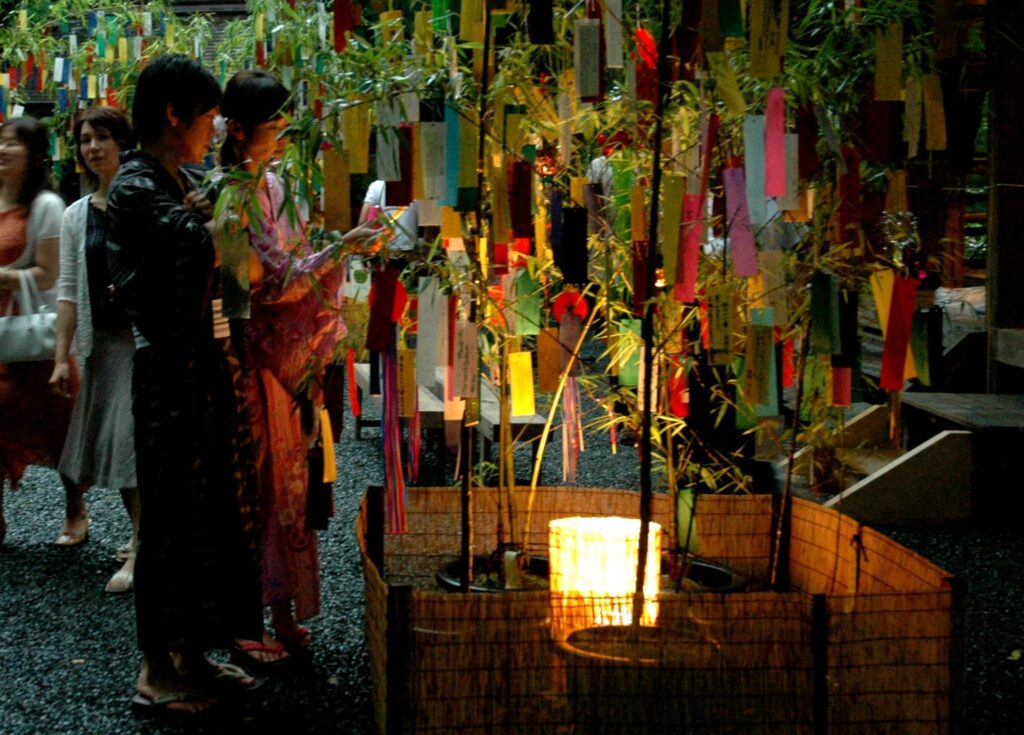
Summer in Japan usually means festival season. From the lively Obon Matsuri, which celebrates one’s ancestors to the various fireworks festivals, which illuminate the night sky, there are plenty of opportunities to celebrate in Japan. One festival that is especially wonderful and magical is the Tanabata Festival.
.
Tanabata, also known as the “star festival,” takes place on the 7th day of the 7th lunar month of the year, when, according to legend, the two stars Altair and Vega, usually separated from each other by the Milky Way, are able to meet. The Japanese Tanabata Festival was inspired by the Chinese Qixi Festival and gained widespread popularity among the general public during the early Edo period (1603-1867).
.
The Qixi Festival originated during the Han dynasty and celebrates the annual meeting of the mythological cowherd and weaver girl. The Chinese legend centers around the forbidden love of Zhinü (weaver girl, symbolizing Vega) and Niulang (cowherd, symbolizing Altair). The lovers were banished to opposite sides of the Silver River (symbolizing the Milky Way) and were able to reunite for only one day when a flock of magpies formed a bridge across the river. This phenomenon took place on the 7th day ofthe 7th lunar month.
.
.
The festival was introduced to Japan by Empress Koken, the last empress to rule Japan until the 17th century, in 755. The Japanese version celebrates the deities, Orihime and Hikoboshi.
.
Orihime (Weaving Princess) was the daughter of Tentei (Emperor of Heaven). She possessed an incredible talent for weaving beautiful cloth by the bank of the Amanogawa (Heavenly River). Tentei loved the cloth woven by his daughter, so she worked very hard day after day. However, Orihime was unhappy because she devoted all of her time to weaving cloth and was not able to meet and fall in love with anyone. Concerned about his daughter’s happiness, Tentei arranged for her to meet Hikoboshi (a cowherd), who lived and worked on the other side of the Amanogawa.
.

.
When the two met, they fell in love instantly and were married shortly thereafter. Once married, Orihime stopped weaving the cloth Tentei loved and Hikoboshi allowed his cows to stray all over Heaven. This angered Tentei and he separated the two lovers on the opposite banks of the Amanogawa and forbade them to meet. Orihime became despondent and begged her father to let them meet again. Tentei was moved by his daughter’s tears and agreed to allow the lovers to meet on the 7th day of the 7th month
only if Orihime worked hard and finished her weaving.
.
The first time the couple tried to meet, they were unable to cross the river because there was no bridge. Orihime cried so much that a flock of magpies came and promised to make a bridge with their wings so that she could cross the river. It is said that if it rains on Tanabata, the magpies cannot come and the two lovers must wait until the following year to meet. Many Japanese wish for good weather on Tanabata so that the lovers can meet. The date when Tanabata is celebrated varies by region in Japan. The original festival date was based on the Japanese lunar calendar, which is about a month behind the Gregorian calendar. As a result, some festivals are held on July 7, while others take place on August 7.
.
.
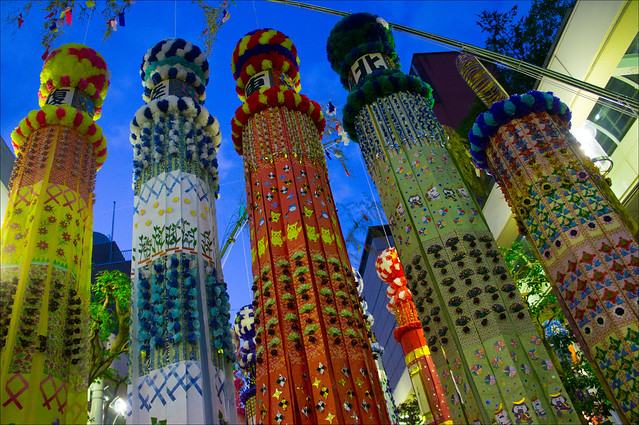
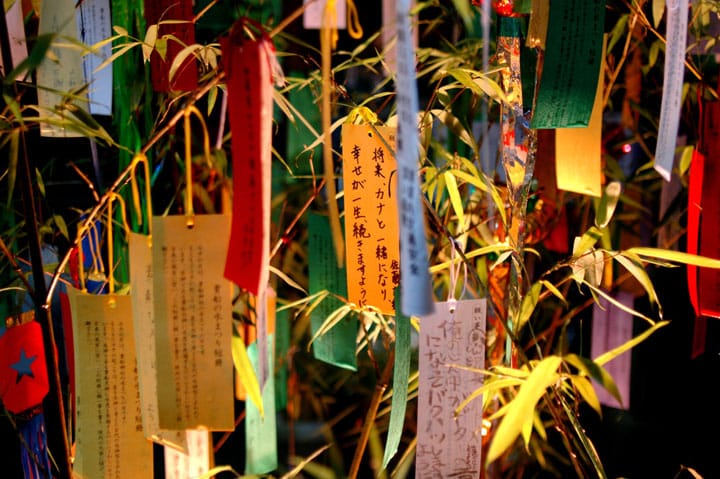
The largest and most famous Tanabata Festival takes place in Sendai from August 6th through the 8th. Japanese people generally celebrate Tanabata by writing their wishes, sometimes in the form of poetry, on small pieces of paper and hanging them on bamboo branches. The decorated bamboo are often set afloat on a river or burned after the festival concludes. You will also see colorful fukinagashi (paper windsock) decorations during Tanabata celebrations. The fukinagashi represent Orihime’s yarn with which she wove her beautiful cloth.
.
Fortunately, the tradition is preserved in many Japanese communities around the world. You will often find bamboo branches with wishes tied to them and colorful fukinagashi decorating the neighborhoods of Little Tokyo in Los Angeles and Japan Town in San Francisco, for instance. You need not travel to Japan to enjoy its delightful summer traditions.
.
Photo Credits: Yuki Yaginuma (Under Creative Commons License)
.
.
『Kristine’s Eye on Japan: Introduction to Japanese Culture』
Writer: Kristine Ohkubo
.
.
.
(3/28/2022)
Share This Article
Related Articles
Pick Up
- Japan Now! Japan Answered. The Monster Falls, and th...
- Japan Now! She Said Yes. Olympic Champions Riku Miur...
- Japan Now! 156 km/h. Bases Loaded. No Outs. Koshien&...
- Japan Now! Whole Torched Purin on a Crepe. Ise’...
- Japan Now! 7,000 Stranded at Narita as Record Rain S...
-

- Japan Now! The Spear Won. Chiben Wakayama Takes Kosh...
- Pokemon Worlds Takes Over San Francisco, and We Got ...
- Japan Now! Doraemon Is Taking a Steam Train to Victo...
- Japan Now! It’s Rice Day in Japan, So Dragon Q...
- Japan Now! The Final Four Is Set. Ariake’s Mir...
- See more TRADITIONAL CULTURE articles >










Latest Articles
- Fall Grand Karaoke Festival in Torrance Enjoy Nosta...
- Looking for a Car? Visit South Bay Toyoya! Reliable...
- WA Dining Suya Enjoy the Flavors of Fall with Limit...
- Free Medicare Seminars, Learn the Besics and Review...
- Den’s Tea ...
-

- Capture Special Memories at Kimono no Kobeya ...
- Recommended for Those on a Diet! Healthy Noodles
- Savor Seasonal Specials at TAKAGI COFFEE!
- Daikokuya El Monte Celebrates 10th Anniversary! ...
- Check Out JINS 360°! New Store Now Open!
- See all articles >