Share This Article



Receiving the Gift of Life
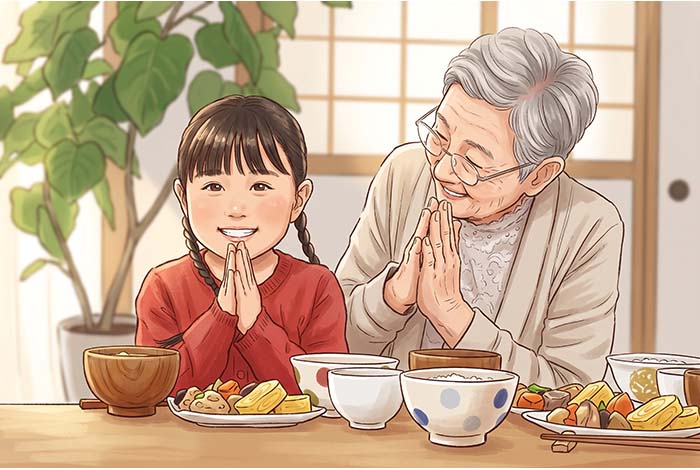
Before taking the first bite of a meal, Japanese people seamlessly clasp their hands together and say “Itadakimasu.” It is often loosely translated as the French “Bon Appétit” or “Let’s eat,” but the true meaning is far more profound. The word literally translates to “I humbly receive.” Rooted deeply in Buddhist and Shinto animism, it is a direct expression of gratitude toward the plants and animals that sacrificed their lives to become your food. You are acknowledging that to sustain your own life, you are humbly receiving the life energy of the ingredients in front of you.
The Invisible Village of Labor
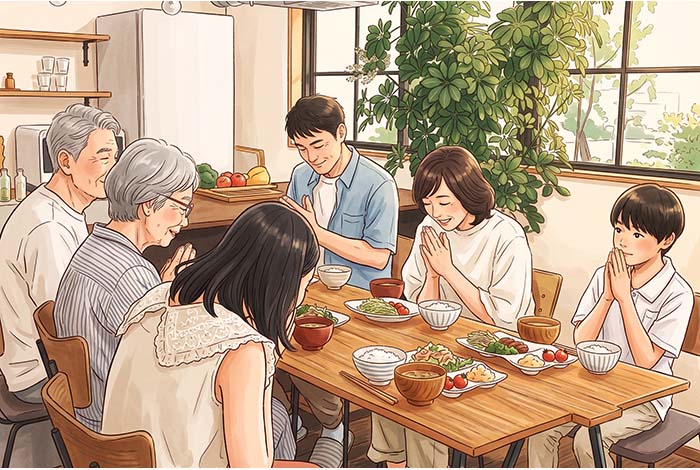
But the gratitude doesn’t stop at the ingredients! “Itadakimasu” is also a massive “thank you” to the invisible village of people who made the meal possible. It is a moment to appreciate the farmers who grew the rice, the truck drivers who transported the vegetables, the supermarket staff, and finally, the chef or family member who spent time cooking it. Saying this phrase is a mental reset, shifting your mindset from hunger to profound appreciation for the entire supply chain and the human effort required just to put a single bowl of food on the table.
👉 Want to read more about Japanese demographics and society?
Read Next: Why Are There Hundreds of Rice Balls in the Supermarket? (The “Onigiri” Universe)

The Ultimate Humble Reply
When the meal is finished, you say “Gochisosama deshita.” The Kanji characters for this phrase (御馳走) literally mean “running around on horseback,” referring to the intense effort the host went through to gather the ingredients and prepare the feast. However, the most uniquely Japanese part is how the cook replies! Instead of saying “You’re welcome,” the chef or mother will often reply with “Osomatsusama deshita,” which translates to “It was a poor, meager meal.” Even if they spent five hours cooking a luxury feast, they will downplay their own effort. It is a brilliant linguistic dance of mutual respect and extreme Japanese humility!
▼ Read Next:
🔗 How Do Japanese People Upgrade Plain Rice?(The Magic of “Takikomi Gohan”)
.
.
Share This Article
Related Articles
Pick Up
- Japan Now! 7,000 Stranded at Narita as Record Rain S...
- Japan Now! She Said Yes. Olympic Champions Riku Miur...
- Japan Now! It’s Rice Day in Japan, So Dragon Q...
- Japan Now! Whole Torched Purin on a Crepe. Ise’...
- Japan Now! The Spear Won. Chiben Wakayama Takes Kosh...
-

- Japan Now! Doraemon Is Taking a Steam Train to Victo...
- Pokemon Worlds Takes Over San Francisco, and We Got ...
- Japan Now! Japan Answered. The Monster Falls, and th...
- Japan Now! 156 km/h. Bases Loaded. No Outs. Koshien&...
- Japan Now! The Final Four Is Set. Ariake’s Mir...
- See more Fun Facts articles >










Latest Articles
- Free Medicare Seminars, Learn the Besics and Review...
- Den’s Tea ...
- Capture Special Memories at Kimono no Kobeya ...
- Recommended for Those on a Diet! Healthy Noodles
- Savor Seasonal Specials at TAKAGI COFFEE!
-

- Daikokuya El Monte Celebrates 10th Anniversary! ...
- Check Out JINS 360°! New Store Now Open!
- Pho-Inspired Asian Spicy Ramen Returns for a Limited...
- Discover JINS’ Revolutionary Multi-Directional Movem...
- Celebrate 10 Years!! Daikokuya El Monte Launches Ann...
- See all articles >