Beyond the Basic Bowl For many Americans, “Ramen” just means whatever flavor is served at the local shop. But in Japan, ramen is a deeply regional religion. Every prefecture fights over who has the best bowl. Out of thousands of variations, three legendary styles are officially crowned as “Japan’s Top 3 Regional Ramens.” Sapporo Ramen (Hokkaido) The king of the snowy north is “Sapporo Ramen.” It is the undisputed champion of Miso flavor. To survive Hokkaido’s freezing winters, chefs use medium-thick, curly noodles topped with stir-fried vegetables (like bean sprouts). Crucially, they cover the soup with a thin layer of…
View More The Big Three: Can You Name Japan’s Top 3 Regional Ramens? (A Noodle Masterclass)Category: LEARNJAPAN
Why Do Japanese Schoolgirls Wear Sailor Outfits? (The British Navy Connection)
The Anime Icon If you have ever watched a Japanese anime or read a manga, you instantly recognize the “Sailor Fuku” (Sailor Uniform). The iconic pleated skirt, large collar, and ribbon are the undisputed global symbols of Japanese youth and school life. A Military Origin But why are high school girls dressed like sailors? The surprising truth is that this cute, pop-culture fashion icon actually originated as a hardcore military uniform worn by the British Royal Navy in the 19th century! The Meiji Modernization During the Meiji and Taisho eras (late 1800s to early 1900s), Japan was rapidly Westernizing and…
View More Why Do Japanese Schoolgirls Wear Sailor Outfits? (The British Navy Connection)Why Can’t You Find a “Teriyaki” Restaurant in Japan? (The Sweet Soy Secret)
The SoCal Fast Food Staple If you drive down almost any major street in Southern California, you will easily spot a Teriyaki restaurant. Massive chains and local mom-and-pop shops selling quick, delicious chicken teriyaki bowls over rice are an absolute staple of the American fast-food diet. The Missing Shops Naturally, many foreign tourists arriving in Tokyo expect to find authentic, dedicated Teriyaki specialty shops on every corner. But if you search for one on Google Maps in Japan, you will be shocked: they essentially do not exist! The Reality of Home Cooking Why is there no Teriyaki fast food? Because…
View More Why Can’t You Find a “Teriyaki” Restaurant in Japan? (The Sweet Soy Secret)Who Was the First Woman to Conquer Mount Everest? (The Legend of Junko Tabei)
The Ultimate Peak Mount Everest is the ultimate test of human endurance. For decades, the summit was an exclusive club for male mountaineers. But in 1975, a 35-year-old Japanese woman named Junko Tabei shattered the ice ceiling and made global history. Defying the 1970s Stereotypes Tabei’s journey wasn’t just a physical battle against freezing temperatures; it was a cultural battle. In 1970s Japan, society firmly believed that a woman’s place was strictly in the home, raising children and serving tea. Finding sponsors for an all-female Himalayan expedition was nearly impossible. The Historic Ascent Despite the intense sexism and lack of…
View More Who Was the First Woman to Conquer Mount Everest? (The Legend of Junko Tabei)Why Do Japanese People Love Black Cats? (The “Fuku Neko” Superstition)
The Halloween Spook In the US and Europe, black cats often get a bad rap. Especially around Halloween, they’re portrayed as spooky creatures bringing bad luck. This superstition dates back to the Middle Ages, when black cats were sadly believed to be witches’ evil companions. The Japanese “Fuku Neko” Cross the Pacific to Japan, and the story flips completely. Historically, Japanese people have adored black cats! Rather than being unlucky, they are celebrated as Fuku Neko (Lucky Cats)—powerful charms that ward off evil and bring good fortune. Business Prosperity During the Edo period, black cats were especially popular among merchants.…
View More Why Do Japanese People Love Black Cats? (The “Fuku Neko” Superstition)What Is the Ultimate Ramen Topping? (Japan’s Official 2023 Ranking)
Customizing Your Bowl Whether you are eating at a famous ramen shop in Torrance or a tiny counter in Tokyo, ordering ramen is highly personal. Beyond choosing the broth (Tonkotsu, Shoyu, Miso), the real debate among ramen lovers is the toppings. But what is truly the most popular choice in Japan? The National Survey In 2023, a massive national survey in Japan finally settled the debate, ranking the undisputed top three ramen toppings. Coming in at #3 is “Menma” (fermented bamboo shoots). It provides a crucial, earthy crunch that perfectly breaks up the soft texture of the noodles. The Runner-Up:…
View More What Is the Ultimate Ramen Topping? (Japan’s Official 2023 Ranking)Did You Know the Hardest Food in the World Is Japanese? (The “Katsuobushi” Miracle)
The Ultimate Jawbreaker If someone asked you to name the hardest food in the world, you might guess a stale baguette or a jawbreaker candy. But according to the Guinness Book of World Records, the hardest food on Earth is a traditional Japanese ingredient: “Katsuobushi” (Dried Bonito Fish). Harder Than Iron It looks like a dusty piece of wood, and its hardness is absolutely terrifying. On the Mohs scale of mineral hardness—where a Diamond is a perfect 10—Katsuobushi scores between a 7 and an 8. It is scientifically considered harder than iron! If you drop it, it clinks like a…
View More Did You Know the Hardest Food in the World Is Japanese? (The “Katsuobushi” Miracle)Why Only Japanese People Can Digest Raw Seaweed? (The Mutant Intestine Mystery)
The Global Sushi Diet Thanks to the global sushi boom, eating “Nori” (seaweed) has become incredibly normal in places like Los Angeles. People confidently munch on spicy tuna rolls and seaweed salads. However, there is a fascinating biological secret hiding inside the Japanese stomach. The Raw Reality The dark green Nori used to wrap your California roll is roasted. But historically in Japan, coastal people frequently ate raw seaweed straight from the ocean. Scientists recently discovered a shocking fact: Only Japanese people have the specific intestinal bacteria required to break down and digest raw Nori! The Stolen Marine DNA How…
View More Why Only Japanese People Can Digest Raw Seaweed? (The Mutant Intestine Mystery)Why Does Japan Have an Army of “Salarymen”? (The Wasei Eigo Mystery)
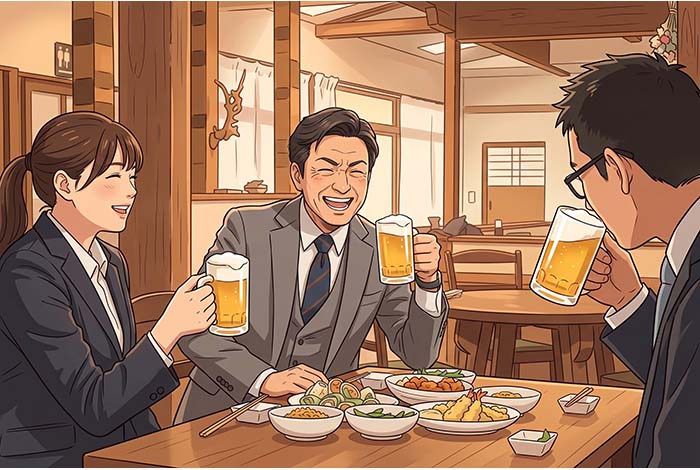
The Sea of Suits If you stand at a major Tokyo train station at 8:00 AM, you will witness a breathtaking sight: thousands of people wearing identical dark suits, carrying briefcases, and marching silently toward their offices. In Japan, these corporate warriors have a very specific name. The “Wasei Eigo” Creation They are called “Salarymen.” To an English speaker, this sounds like a comic book superhero whose superpower is earning a paycheck. But it is actually a classic example of “Wasei Eigo” (Japanese-made English)—words that sound English but were entirely invented in Japan. It simply means an office worker or…
View More Why Does Japan Have an Army of “Salarymen”? (The Wasei Eigo Mystery)Why Are Japanese Graduations So Quiet? (The Silent Choreography of “Sotsugyoshiki”)
The Hollywood Celebration In the US, high school and college graduations are massive, loud celebrations. Families blow air horns from the bleachers, students decorate their mortarboard caps, and at the end, everyone joyfully throws their hats into the sky. In Japan, the atmosphere is the exact opposite. The Solemn Ritual A Japanese graduation, known as “Sotsugyoshiki,” is a profoundly serious, formal, and highly emotional ritual. There is no cheering, no cap-tossing, and absolutely no customized outfits. Students usually wear their crisp school uniforms or, for university, elegant traditional Hakama or formal black suits. The Strict Choreography The entire ceremony is…
View More Why Are Japanese Graduations So Quiet? (The Silent Choreography of “Sotsugyoshiki”)The Greatest Sushi Lie: What Does “Negitoro” Actually Mean? (The Hidden Bone Scrapings)
The Sushi Menu Favorite If you go to any sushi restaurant, from high-end Ginza counters to casual conveyor-belt chains in Torrance, you will find “Negitoro” on the menu. It is a delicious, soft, minced fatty tuna usually served in a sushi roll or on top of a rice bowl, often sprinkled with chopped green onions. The Green Onion Misunderstanding If you speak a little Japanese, the name seems obvious. “Negi” means green onion, and “Toro” means fatty tuna. Therefore, Negitoro means fatty tuna with green onions, right? Shockingly, this is a massive linguistic misunderstanding! The “Negi” in Negitoro has nothing…
View More The Greatest Sushi Lie: What Does “Negitoro” Actually Mean? (The Hidden Bone Scrapings)Why Do Normal Japanese People Live in “Mansions”? (The Ultimate Real Estate Misunderstanding)
The Beverly Hills Expectation If you make a new Japanese friend in Los Angeles and they casually tell you, “I live in a Mansion back in Tokyo,” your jaw might drop. You will immediately imagine them living like a Hollywood celebrity in Beverly Hills, with a sprawling estate, ten bedrooms, and a massive swimming pool. The Concrete Reality But in Japan, the word “Mansion” (マンション) is another tricky piece of “Wasei Eigo” (Japanese-made English). It has absolutely nothing to do with a luxury estate. In Japanese, a “Mansion” simply means a multi-story, concrete condominium or apartment building. Apartment vs. Mansion…
View More Why Do Normal Japanese People Live in “Mansions”? (The Ultimate Real Estate Misunderstanding)