
Share This Article



Last updated: June 9, 2026

Yuki Mitsufuji
Profession: Visiting Professor, NYU Steinhardt School / Industrial Researcher
Born: Kashiwa, Chiba Prefecture, Japan
Education: Master’s degree in Engineering; PhD from the University of Tokyo, Graduate School of Information Science and Technology
Career Highlights: Studied at IRCAM in France (2011). Worked across academia and industry in the field of AI and music technology. Since 2024, based in New York as a visiting professor at NYU Steinhardt. Recipient of the 2025 Keio University Yagami Award for contributions to music source separation technology and its social implementation.
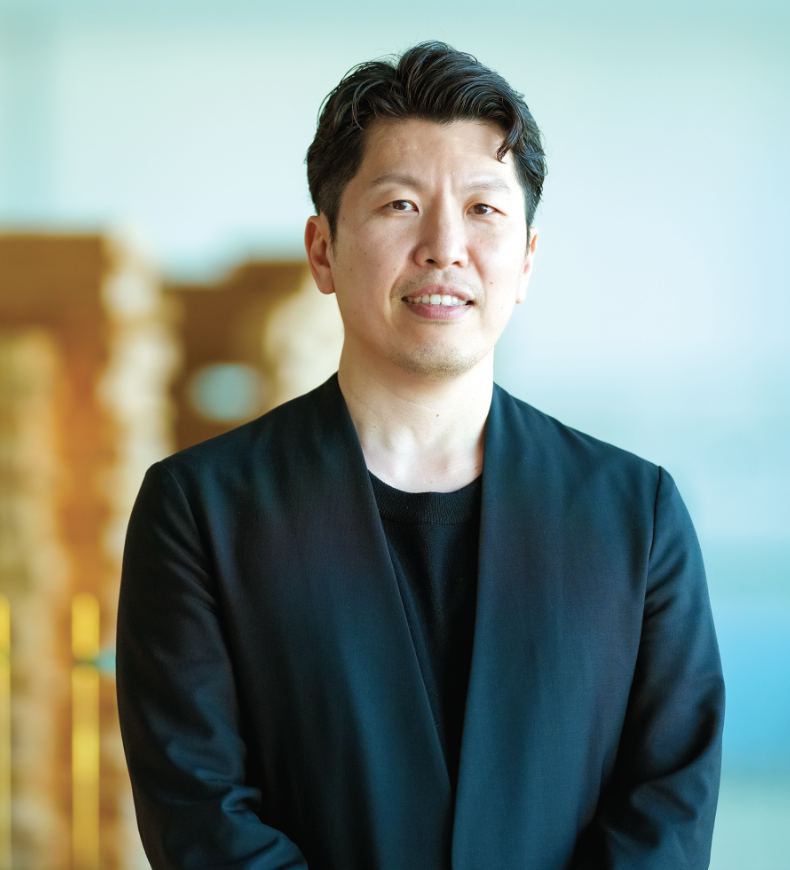
■Yuki Mitsufuji, Industrial Researcher
“I originally wanted to become an artist. But at some point, I changed direction and decided I wanted to support artists instead. That is who I am today.”
Yuki Mitsufuji is a researcher working at the intersection of artificial intelligence and entertainment, currently serving as a visiting professor at New York University’s Steinhardt School since 2024.
What kind of life journey led him to this point?
■ Early Life Between Japan and the United States
Born in 1978 in Kashiwa, Chiba Prefecture, Mitsufuji grew up in a household deeply influenced by both engineering and language. His mother is a language education author with multiple published books, and his father is a business professional with an engineering background. Due to his father’s work assignment, he spent part of his elementary school years (4th and 5th grade) in Boston, USA.
At home, Western music was always playing. Soul and R&B became natural parts of his musical foundation. Even during the J-pop boom of the 1990s, he found himself drawn more to artists like Michael Jackson and Stevie Wonder.
■ University Years: Science, Music, and Performance
Strong in both mathematics and English, he entered the Faculty of Science and Technology at Keio University after high school.
It was also during this period that his musical activities became serious. At Keio University he worked as a vocalist, and at Rikkyo University he played bass. He even attended a school to train as a vocal coach. These four years were entirely devoted to music.
After earning his master’s degree in 2004, he began working while continuing his academic pursuits. Determined to advance his research in information engineering, he pursued a PhD at the University of Tokyo’s Graduate School of Information Science and Technology while simultaneously working full-time. His path reflected relentless dedication.
■ A Turning Point in France: The Birth of a Research Vision
In 2011, Mitsufuji spent a year studying at IRCAM (Institut de Recherche et Coordination Acoustique/Musique) in France, a world-renowned institute where researchers and musicians work together to advance music creation and technology.
At the time, immersive audio content was beginning to attract attention. Ideally, creating immersive experiences required separating and individually processing each sound source—vocals, piano, drums, guitar—adjusting volume and spatial positioning independently. However, audio separation technology was still underdeveloped, making this extremely difficult.
This challenge became a turning point. He began to believe that if sound separation technology could be significantly improved, it could greatly contribute to the entertainment industry.
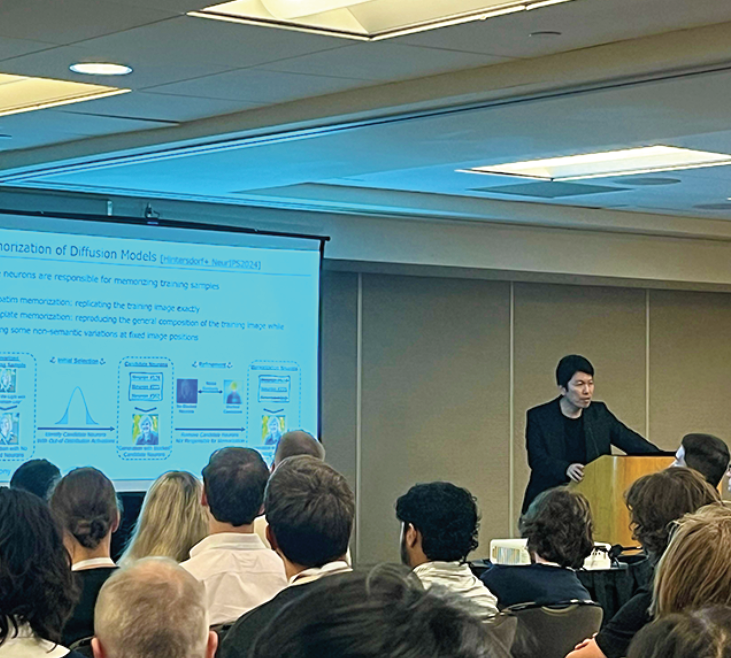
■ Lecturing at an International Conference
■ AI, Music, and the Future of Creativity
“Music generated by AI often makes it unclear whose work it is based on, and as a result, there is no proper mechanism to return value to the original artists in terms of monetization. I love music, so I understand how meaningful this work is, and I hope more wonderful artists will continue to emerge. To make that possible, we need systems that properly return value to them.”
In 2025, his research and development in music source separation technology—and its real-world implementation—was recognized with the prestigious Yagami Award from his alma mater, Keio University.
“Generative AI is affecting creative fields in many ways. If we can build the right systems, we can expand the possibilities of content creation, allowing more people to experience new forms of music and visual expression.”

■ Family Travel Photo
Share This Article
Related Articles
Pick Up
- [Japanese Interviews: Life in LA] Chizuko Higuchi : ...
- [Japanese Interviews: Life in LA] Yukari Fowler : Tr...
- [ Interview ] Yuriyan Retriever – Comedian | N...
- [Japanese Interviews: Life in LA] Arisa Nakamura : “...
- [Japanese Interviews: Life in LA] Dan Sawada : “I Ta...
-

- I LIVE IN JAPAN / Bernard McEntee / Teacher
- The Front Line of Anime Music “Yoko Takahashi ...
- [Japanese Interviews: Life in LA] Kent Hayashi : The...
- I LIVE IN JAPAN / Mathilde DUBOIIS / Co-founder of t...
- [Japanese Interviews: Life in LA] Izumi Mitsuda : I’...
- See more Interview articles >




Latest Articles
- Free Medicare Seminars, Learn the Besics and Review...
- Den’s Tea ...
- Capture Special Memories at Kimono no Kobeya ...
- Recommended for Those on a Diet! Healthy Noodles
- Savor Seasonal Specials at TAKAGI COFFEE!
-

- Daikokuya El Monte Celebrates 10th Anniversary! ...
- Check Out JINS 360°! New Store Now Open!
- Pho-Inspired Asian Spicy Ramen Returns for a Limited...
- Discover JINS’ Revolutionary Multi-Directional Movem...
- Celebrate 10 Years!! Daikokuya El Monte Launches Ann...
- See all articles >