Share This Article




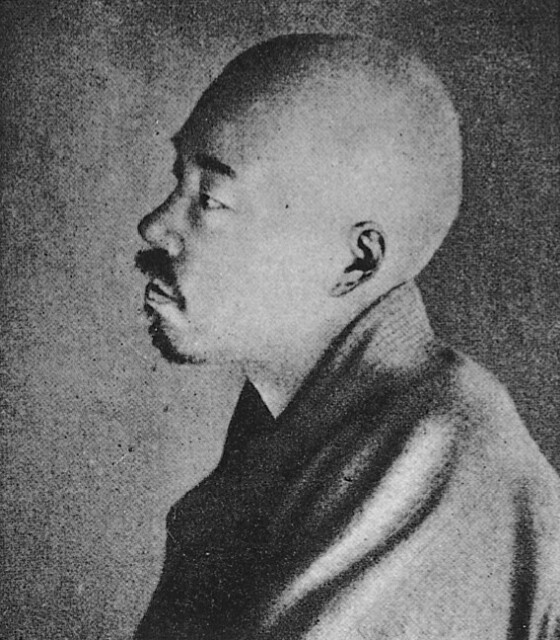
1867 – 1902
正岡子規
Masaoka Shiki
A Literary Figure Who Revitalized Modern Haiku and Opened New Paths for Language from His Sickbed
.
Early Life and the Formation of His Literary Interests
Masaoka Shiki was born in 1867 in what is now Matsuyama City, Ehime Prefecture. His real name was Masaoka Tsunenori. From an early age, he loved reading and grew up immersed in Chinese poetry and classical Japanese literature. After the death of his father, he was raised by his mother and grandmother. Although the family was not wealthy, he was fortunate to grow up in a culturally rich environment surrounded by books. His early training in Chinese poetry and classical texts later became the foundation for the vocabulary and expressive precision that shaped his haiku.
Matsuyama had long been a center of haikai and waka culture since the Edo period. Local poetry gatherings and haiku magazines circulated widely, giving Shiki access to a vibrant literary network. During his time at Matsuyama Middle School, he met Natsume Sōseki—who would later become one of the most important novelists of modern Japanese literature and the author of I Am a Cat. The two young men stimulated each other intellectually, frequently discussing literature and the nature of expression. Their early exchanges had a lasting influence on both writers. Sōseki would later describe Shiki as “a genius of haiku” and continued to hold deep respect for him throughout his life.
Drawing on the classical knowledge he had absorbed since childhood, Shiki developed a strong interest in haiku in his late teens. He interacted with local haiku poets, participated in poetry gatherings, and discovered the appeal of expressing natural scenes and everyday life within a short poetic form. These experiences laid the groundwork for what would later become his central reformist principle: shasei, or “sketching from life.”
Haiku Reform and the Advocacy of “Shasei”
In 1892, Shiki moved to Tokyo, where he worked for a newspaper while continuing his study of haiku. At the time, the haiku world tended to revere legendary figures such as Matsuo Bashō to the point of rigidity. Formulaic expressions and technical manipulation of seasonal words were prized, while poems depicting real life or concrete natural scenes had become rare. Shiki saw this as a stagnation of expression—form had overtaken substance—and he felt strongly that reform was necessary.
He proposed the concept of shasei, or “sketching from life.” This approach emphasized observing nature and everyday scenes directly and describing them as they were, without subjective embellishment or fanciful wordplay . Instead of relying on imagination or linguistic tricks, shasei demanded close attention to the world as it is. His well‑known haiku—
“When I bite into a persimmon, a bell tolls at Hōryū‑ji.”
—captures a simple moment during his travels and is widely regarded as a quintessential example of the shasei spirit. Shiki applied the same principles to tanka, advocating for straightforward expression rather than dependence on classical techniques.
Shiki’s reforms had a profound impact on contemporary poets. Figures such as Takahama Kyoshi and Kawahigashi Hekigotō inherited and expanded his ideas, further developing haiku expression from the late Meiji into the Taishō period. These poets, directly or indirectly influenced by Shiki’s guidance, helped establish the foundation of modern haiku.
His Passion for Baseball and His Role as an Early Chronicler
Shiki was also fascinated by baseball at a time when the sport was just beginning to spread in Japan. As a student, he played as a catcher and enthusiastically promoted the appeal of the game. In newspaper articles, he recorded matches in vivid detail, using a style remarkably similar to modern sports journalism. He is even credited with helping popularize the English term “baseball” in Japanese.
Although illness prevented him from continuing as an active player, his interest never faded. Even from his sickbed, he followed match results and shared his thoughts about the games. In recognition of his early contributions to the sport, the “No‑Ball Museum” in his hometown of Matsuyama displays materials related to Shiki’s involvement with baseball, including match records and equipment from his era. These exhibits reveal a side of Shiki that differs from his literary persona—a young man eager to embrace new cultural influences.
Struggle with Illness and Creative Work from His Sickbed
Shiki suffered from tuberculosis from his late twenties, and his condition gradually worsened.
By his early thirties, he could barely walk, and a large abscess formed on his back, causing severe pain. Despite this, he never stopped writing. He produced numerous haiku, tanka, and essays during this period. His famous essay collection Byōshō Rokushaku (A Six‑Foot Sickbed) records his observations and reflections from the confined space of his room.
The line “My six‑foot sickbed is my universe” is often cited as a testament to his ability to view his circumstances with calm objectivity.
Even as his illness progressed, he continued to note the changing seasons and the small events around him, demonstrating an unwavering literary curiosity.
From Matsuyama to Hōryū‑ji: Places Connected to Shiki
Matsuyama, Shiki’s birthplace, preserves many sites and facilities related to his life and achievements. One of the most notable is Shikidō, a memorial hall built on the site of his final residence. It houses his desk, inkstone, brushes, and other personal belongings, offering a concrete sense of his creative environment during his final years. These materials are invaluable to literary history.
Other sites in Matsuyama trace his childhood and early poetic training, including areas around the old castle town. Today, Matsuyama is known as “the city of haiku,” with haiku mailboxes placed throughout the city where residents and visitors can freely submit their poems.
In Nara, within the grounds of Hōryū‑ji Temple, a stone monument engraved with his famous persimmon haiku stands beside the Kagami‑ike Pond. Visitors can stand before the monument and imagine the scene Shiki captured more than a century ago.
Masaoka Shiki’s Final Years and Lasting Influence
Shiki died in 1902 at the age of 34, weakened by tuberculosis and spinal caries. His life was short, but his ideas reshaped Japanese poetic culture. His advocacy of shasei introduced realism and personal perspective into haiku, encouraging later poets to value direct observation of nature and everyday life. His influence extended beyond haiku to diaries and essays, where his restrained yet concrete descriptive style broadened the expressive possibilities of modern Japanese literature.
Today, haiku is enjoyed not only in Japan but around the world. Through education, international haiku gatherings, and global literary exchange, Shiki’s legacy continues to shape how people understand the power of capturing the world in a few carefully chosen words. His work redefined the appeal of haiku, and his ideas remain vital to this day.
Share This Article
Related Articles
Pick Up
- JAPANESE SAMURAI /Sugawara no Michizane
- JAPANESE SAMURAI / Tokugawa Yoshinobu
- JAPANESE SAMURAI /Tsutaya Jūzaburō
- JAPANESE SAMURAI / Shigenobu Okuma
- JAPANESE SAMURAI / John Manjirō
-

- JAPANESE SAMURAI / Raichō Hiratsuka
- JAPANESE SAMURAI /Ashikaga Takauji
- JAPANESE SAMURAI /Tsunenaga Hasekura
- JAPANESE SAMURAI /Iwakura Tomomi
- JAPANESE SAMURAI / Sakanoue no Tamuramaro
- See more History articles >





Latest Articles
- Free Medicare Seminars, Learn the Besics and Review...
- Den’s Tea ...
- Capture Special Memories at Kimono no Kobeya ...
- Recommended for Those on a Diet! Healthy Noodles
- Savor Seasonal Specials at TAKAGI COFFEE!
-

- Daikokuya El Monte Celebrates 10th Anniversary! ...
- Check Out JINS 360°! New Store Now Open!
- Pho-Inspired Asian Spicy Ramen Returns for a Limited...
- Discover JINS’ Revolutionary Multi-Directional Movem...
- Celebrate 10 Years!! Daikokuya El Monte Launches Ann...
- See all articles >