Share This Article




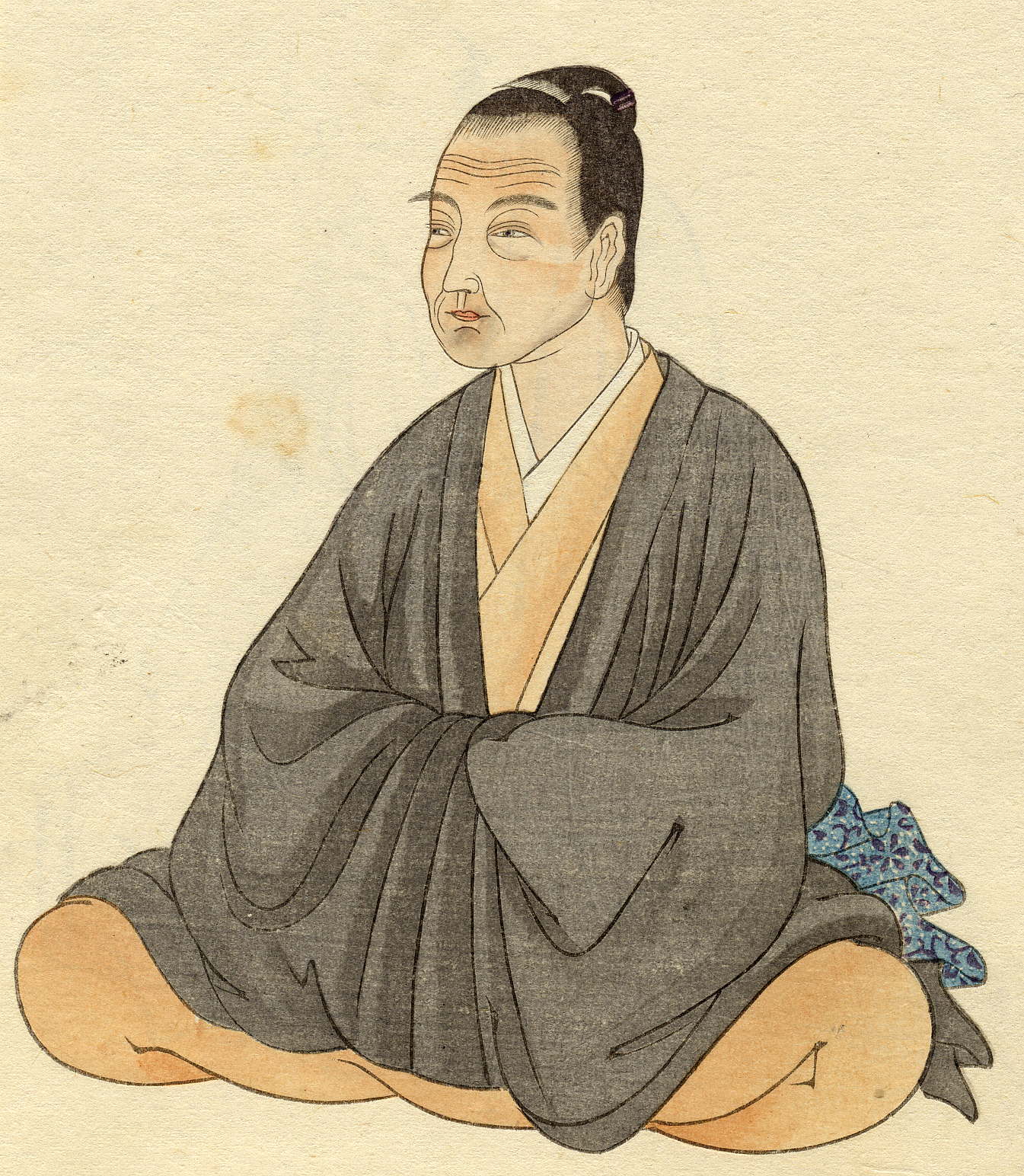
1730 – 1801
本居宣長
Motoori Norinaga
The Scholar Who Unearthed the Sensibility of Japanese Culture
.
If you have ever felt a bittersweet ache at falling cherry blossoms, you already understand mono no aware. This uniquely Japanese sense of beauty was named and defined by one scholar: Motoori Norinaga.
Motoori Norinaga, born in 1730 in what is now Matsusaka City in Mie Prefecture, is remembered as the scholar who illuminated the emotional core of Japanese culture—mono no aware, the deep sensitivity to the beauty and sorrow of human experience. His life traces the path of a boy captivated by books who grew into one of Japan’s most influential thinkers, shaping the study of classical literature for generations.
Early Life: A Book-Loving Child in a Bustling Town
Norinaga was born into a prosperous family of cotton merchants in Matsusaka, a lively post town filled with travelers on their way to the Ise Grand Shrine (Ise Jingu). The constant flow of pilgrims and merchants brought stories, books, and information from across the country, making the town a natural crossroads of culture.
Although expected to inherit the family business, Norinaga was far more drawn to reading than to commerce. He devoured Chinese classics, Japanese literature, and essays, fascinated by the sound of words and the worlds they created.
As a teenager, he was sent to Edo (Tokyo) to train in a merchant household. But instead of learning trade skills, he spent his days reading. After a year, he was deemed unfit for business and sent back home—an early turning point that set him on a different path and revealed where his true passion lay.
A Giant Map and a Growing Curiosity
Back in Matsusaka, Norinaga spent two years immersed in study. During this period, he created a massive hand‑drawn map of Japan, roughly the size of a tatami mat, about 3 by 6 feet. Using geography books and stories from travelers, he attempted to capture the shape of the nation with his own hands.
This project reflected his intense curiosity and his desire to understand the world through careful observation. Living in a town where information naturally gathered, he absorbed knowledge that broadened his intellectual horizons and deepened his desire to pursue scholarship.
Becoming a Physician: A Practical Path to Scholarship
Recognizing that her son lacked talent for commerce but possessed a passion for learning, Norinaga’s mother encouraged him to become a physician—a profession that offered both financial stability and time for study. Norinaga agreed, and at age 22 he moved to Kyoto, the cultural and academic center of the time.
For five years he studied medicine, but he also plunged deeply into classical literature, history, and languages. He frequented bookstores, visited scholars, and explored the world of ancient texts. Kyoto, with its vibrant intellectual atmosphere, opened his mind to the vastness of scholarship. At 28, he returned to Matsusaka and opened a medical practice, beginning a life divided between daytime medical work and nighttime study.
Two Faces: Physician and Scholar
Norinaga’s dual life produced a striking contrast in his writings. His scholarly manuscripts were written in beautifully neat characters, almost like printed text. His medical notes, however, were notoriously messy—barely legible scribbles.
The difference revealed his priorities: medicine was practical work for daily living, while classical study was his true calling. This contrast also shows how clearly he separated the demands of daily life from the intellectual world he cherished.
Encounter with Kamo no Mabuchi: A Life-Changing Moment
Shiki died in 1902 at the age of 34, weakened by tuberculosis and spinal caries. His life was short, but his ideas reshaped Japanese poetic culture. His advocacy of shasei introduced realism and personal perspective into haiku, encouraging later poets to value direct observation of nature and everyday life. His influence extended beyond haiku to diaries and essays, where his restrained yet concrete descriptive style broadened the expressive possibilities of modern Japanese literature.
Today, haiku is enjoyed not only in Japan but around the world. Through education, international haiku gatherings, and global literary exchange, Shiki’s legacy continues to shape how people understand the power of capturing the world in a few carefully chosen words. His work redefined the appeal of haiku, and his ideas remain vital to this day.
Encounter with Kamo no Mabuchi: A Life-Changing Moment
Shiki died in 1902 at the age of 34, weakened by tuberculosis and spinal caries. His life was short, but his ideas reshaped Japanese poetic culture. His advocacy of shasei introduced realism and personal perspective into haiku, encouraging later poets to value direct observation of nature and everyday life. His influence extended beyond haiku to diaries and essays, where his restrained yet concrete descriptive style broadened the expressive possibilities of modern Japanese literature.
Today, haiku is enjoyed not only in Japan but around the world. Through education, international haiku gatherings, and global literary exchange, Shiki’s legacy continues to shape how people understand the power of capturing the world in a few carefully chosen words. His work redefined the appeal of haiku, and his ideas remain vital to this day.he difference revealed his priorities: medicine was practical work for daily living, while classical study was his true calling. This contrast also shows how clearly he separated the demands of daily life from the intellectual world he cherished.
The Kojikiden: A 35-Year Scholarly Achievement
While continuing his medical practice, Norinaga spent his nights painstakingly analyzing the Kojiki. He examined every word, every phrase, and every nuance of ancient Japanese. The result was the Kojikiden, a massive commentary completed over 35 years. It remains one of the most important works in the study of early Japanese literature and mythology.
Norinaga’s method was groundbreaking. He avoided imposing later moral or philosophical frameworks on ancient texts. Instead, he sought to understand how people of the past felt, spoke, and perceived the world. This approach laid the foundation for modern philology and reshaped the study of Japanese classics, influencing scholars well into the modern era.
“Mono no Aware”: The Heart of Japanese Literature
At the center of Norinaga’s thought is mono no aware—the idea that the essence of literature lies in the honest expression of human emotion. He believed that joy, sorrow, longing, and the subtle shifts of the heart were not weaknesses but the core of human truth.
He regarded The Tale of Genji as the pinnacle of Japanese literature because it portrayed emotional nuance with unmatched depth. In an era dominated by Confucian rationalism and Buddhist detachment, Norinaga’s affirmation of natural human feeling was revolutionary. Today, mono no aware remains a key concept in understanding Japanese aesthetics, influencing literature, film, and even contemporary animation.
A Scholar Connected to His Community
Norinaga’s home became a gathering place for students and townspeople. He taught, lectured, and discussed ideas openly. His daily interactions with patients and neighbors grounded his scholarship in real human experience. This connection to ordinary life helped shape his warm, human-centered approach to literature and emotion, preventing his work from becoming abstract or detached.
Legacy in Matsusaka
In Matsusaka City today, Norinaga’s former residence, known as the “Suzunoya,” and the Motoori Norinaga Memorial Museum preserve his books, tools, and study room. Visitors can imagine the quiet environment where he pursued his lifelong quest to understand the spirit of ancient Japan. The town is also famous for Matsusaka beef, one of Japan’s most renowned premium wagyu brands, making it a place where history, culture, and cuisine come together.
Final Years and Enduring Influence
Norinaga continued his research even as his health declined. He died in 1801 at the age of 72. His students carried on his work, contributing to the development of Kokugaku as a major intellectual movement. His meticulous approach to classical texts shaped modern Japanese literary studies, and his concept of mono no aware remains central to discussions of Japanese culture. Through his writings, Norinaga continues to influence how people understand emotion, literature, and the Japanese spirit.
Mono no Aware FAQ
What does “mono no aware” mean?
Mono no aware is a Japanese concept often translated as “the pathos of things” or a gentle sadness at the impermanence of life. It describes the bittersweet awareness that beauty, like cherry blossoms, is moving precisely because it does not last.
Who came up with mono no aware?
The scholar Motoori Norinaga (1730 to 1801) defined and popularized the term in the Edo period. He argued that this sensitivity to emotion, not moral lessons, was the true heart of Japanese literature.
What is an example of mono no aware?
The classic example is viewing cherry blossoms. Their beauty feels deeper because the petals fall so quickly, blending joy and sadness in the same moment. The same feeling appears in autumn leaves and the sound of summer cicadas.
Is mono no aware still relevant today?
Yes. The concept still shapes Japanese literature, film, and animation. Directors like Hayao Miyazaki and Yasujiro Ozu are often described as capturing mono no aware in their quiet, emotionally resonant scenes.
Related Articles
Wikipedia
https://en.wikipedia.org/wiki/Motoori_Norinaga
Share This Article
Related Articles
Pick Up
- JAPANESE SAMURAI / Shigenobu Okuma
- JAPANESE SAMURAI / Sakanoue no Tamuramaro
- JAPANESE SAMURAI / Raichō Hiratsuka
- JAPANESE SAMURAI / Tokugawa Yoshinobu
- JAPANESE SAMURAI / John Manjirō
-

- JAPANESE SAMURAI /Tsutaya Jūzaburō
- JAPANESE SAMURAI /Sugawara no Michizane
- JAPANESE SAMURAI /Iwakura Tomomi
- JAPANESE SAMURAI /Ashikaga Takauji
- JAPANESE SAMURAI /Tsunenaga Hasekura
- See more History articles >


Latest Articles
- Free Medicare Seminars, Learn the Besics and Review...
- Den’s Tea ...
- Capture Special Memories at Kimono no Kobeya ...
- Recommended for Those on a Diet! Healthy Noodles
- Savor Seasonal Specials at TAKAGI COFFEE!
-

- Daikokuya El Monte Celebrates 10th Anniversary! ...
- Check Out JINS 360°! New Store Now Open!
- Pho-Inspired Asian Spicy Ramen Returns for a Limited...
- Discover JINS’ Revolutionary Multi-Directional Movem...
- Celebrate 10 Years!! Daikokuya El Monte Launches Ann...
- See all articles >