
Share This Article



The 200% Capacity Nightmare
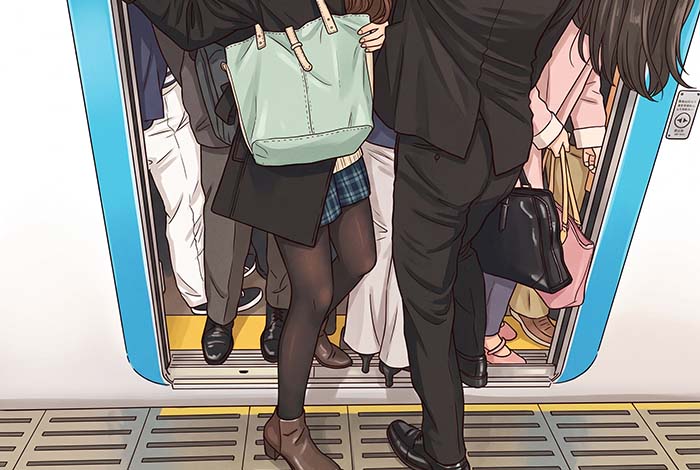
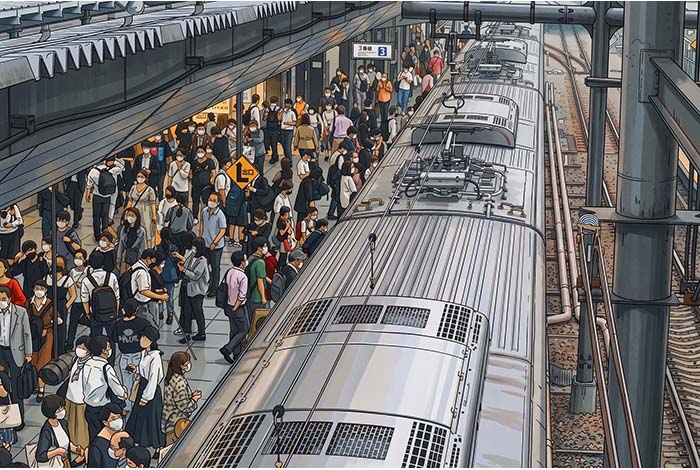
Japanese trains are globally famous for being clean, quiet, and perfectly on time. But if you try to ride the Tokyo subway during the morning rush hour (between 7:30 AM and 9:00 AM), that peaceful image will be instantly destroyed. This is the legendary Japanese commuter hell. During these peak hours, trains do not just reach 100% capacity—they regularly hit 150% to 200% capacity! The train cars are packed so incredibly tight that your feet might not even touch the floor, and reading a book or looking at your smartphone becomes physically impossible.
Enter the “Oshiya”
In the United States, if a subway car is full, you simply wait for the next one. But in Tokyo, millions of corporate warriors cannot be late for work. When the train is overflowing and the sliding doors cannot close, the station deploys a special team of workers known as “Oshiya” (Train Pushers). Wearing crisp uniforms and clean white gloves, their literal job is to place their hands on the backs and shoulders of the passengers and physically shove them deeper into the train car until the doors can finally slide shut. It looks exactly like someone trying to overstuff a suitcase!
👉 Want to read more about Japanese demographics and society?
Read Next: Do Your Makeup on a Japanese Train? (The Morning Commute Debate)

The Silent Endurance
What is truly shocking to foreign tourists is not just the pushing, but the absolute silence. Despite being crushed against the glass windows and squished shoulder-to-shoulder with hundreds of strangers, the passengers do not yell, complain, or fight. Everyone silently and politely endures the extreme physical discomfort. It is an incredible, daily display of Japanese stoicism and collective harmony, sacrificing personal comfort to ensure the massive metropolis keeps moving perfectly on schedule.
▼ Read Next:
🔗 Why Smart Travelers Don’t Buy Paper Train Tickets in Tokyo?
.
.
Share This Article
Related Articles
Pick Up
- Japan Now! The Final Four Is Set. Ariake’s Mir...
- Japan Now! 7,000 Stranded at Narita as Record Rain S...
- Japan Now! 156 km/h. Bases Loaded. No Outs. Koshien&...
- Japan Now! Japan Answered. The Monster Falls, and th...
- Japan Now! The Spear Won. Chiben Wakayama Takes Kosh...
-

- Japan Now! It’s Rice Day in Japan, So Dragon Q...
- Japan Now! She Said Yes. Olympic Champions Riku Miur...
- Japan Now! Doraemon Is Taking a Steam Train to Victo...
- Japan Now! Whole Torched Purin on a Crepe. Ise’...
- Pokemon Worlds Takes Over San Francisco, and We Got ...
- See more Fun Facts articles >








Latest Articles
- Free Medicare Seminars, Learn the Besics and Review...
- Den’s Tea ...
- Capture Special Memories at Kimono no Kobeya ...
- Recommended for Those on a Diet! Healthy Noodles
- Savor Seasonal Specials at TAKAGI COFFEE!
-

- Daikokuya El Monte Celebrates 10th Anniversary! ...
- Check Out JINS 360°! New Store Now Open!
- Pho-Inspired Asian Spicy Ramen Returns for a Limited...
- Discover JINS’ Revolutionary Multi-Directional Movem...
- Celebrate 10 Years!! Daikokuya El Monte Launches Ann...
- See all articles >